Total Pageviews

Monday, December 5, 2011

Curiosity: Did God create the universe?

Curiosity: Did God create the universe?

Photo NASA
Stephen Hawking
Published: 12 November 2011(GMT+10)
This Discovery Channel TV program “examines the creation of the universe through the commentary and opinions of Professor Stephen Hawking”.1 The aim appears to be to show that the concept of God is unnecessary for the creation of the universe, and hence likewise for life.

Making a universe

According to Prof. Hawking, you need two basic ingredients to make a universe. These are energy and space, and he tells us: “At the moment of the big bang, an entire universe of energy came into existence, and with it space.” He goes on to say: “The laws of physics demand the existence of something called negative energy.” And he illustrates this by showing a man with a shovel in his hand walking towards the centre of a flat field. The man then starts digging a hole, simultaneously making a small mound or hill by piling up the earth out of the hole onto his hill.
Prof. Hawking then tells us:
“The hole is the negative version of the hill. When the big bang produced a vast amount of positive energy, it simultaneously produced the same amount of negative energy. In this way, the positive and the negative add up to zero—always; it is a law of nature.”
The worthy Professor presumably hopes you didn’t notice two things that negate most of what he says about the big bang. These are:
  1. The formation of the hill needed a cause—the man with the shovel.
  2. This ‘cause’, i.e. the man, existed in time before he started to build the hill.
Prof. Hawking then asks: “Where is all this negative energy today?” and he answers his own question:
Explosion
“It’s in space. According to the laws of nature concerning gravity and motion, space itself is a vast store of negative energy, enough to ensure that everything adds up to zero. The endless web of billions of galaxies pulling on each other by the force of gravity acts as a vast storage device. The positive energy is like the hill. The negative energy is spread throughout space. It means that if the universe adds up to nothing, you don’t need a God to create it. The universe is the ultimate free lunch.”

What triggered it?

Prof. Hawking moves on to ask what caused the spontaneous appearance of the universe, and he replies to that question with the answer: “The laws of nature tell us that nothing caused the big bang.” This, of course, raises the philosophical problem of whether anything can create itself, because until it exists, it is not in a position to cause itself.2
Prof. Hawking avoids this by appealing to ‘quantum mechanics at the sub-atomic level’. Here, he says,
“ … you enter a world where conjuring something out of nothing is possible, at least for a short time, because of quantum mechanics. … The universe was once very small, less than the size of a proton. This means the universe could pop into existence without violating the known laws of physics.”
Scientist critics of the big bang theory, Alex Williams and Prof. John Hartnett, comment:
… the laws of quantum physics would have had to already be in existence, so one could not say that the universe created itself ‘out of nothing’.
“So is it possible that the universe just popped into existence out of the vacuum through nothing more than a quantum fluctuation? Some people think so, although they seem to conveniently forget that the laws of quantum physics would have had to already be in existence, so one could not say that the universe created itself ‘out of nothing’. Others have pointed out, however, that the lifetime of quantum events is inversely proportional to the mass of the object and this precludes any such cosmological quantum event. If a universe did pop into existence by quantum fluctuation, nobody would notice—the lifetime of a quantum event the size of our universe would be less than 10-103 seconds. Moreover, virtual particles today appear within the vacuum of space. In the primordial singularity there was no space and so no vacuum.”3

Cause and effect need time

Prof. Hawking concludes by telling us that time began at the big bang, and so the big bang had no cause, because
“ … there was no time before the big bang for the cause to happen. There was no time for God to exist in. What happened at the beginning of the universe is the final key for removing the need of a creator of the universe. … There is no God who directs our fate. There is probably no heaven and no after-life either. We have just one life to appreciate the grand design of the universe, and for that I am extremely grateful.”
Both the hill and the hole needed a cause, and the cause existed in time before the hill-building began.
But wait a minute, Prof. Hawking, you have just destroyed your analogy of the hill and the hole as an explanation of the formation of the universe. Both the hill and the hole needed a cause, and the cause existed in time before the hill-building began. Furthermore the Bible indicates that God exists outside of time.

Setting the record straight

  1. First of all, for skeptics like Stephen Hawking to maintain their atheistic faith they must provide a naturalistic explanation for everything that the Bible attributes to the power and will of Almighty God. This includes the creation of the universe; the big bang is the current naturalistic atheistic explanation. There have been, and are, others.4
  2. God tells in the Bible not only how He created the universe, but also when. It was not by means of anything resembling today’s big bang theory. He commanded the universe and all things in it into existence (Genesis ch. 1), beginning with the Earth (Genesis 1:2). And He tells us that this was recently, i.e. about 6,000 years ago.
  3. Time was one of the things that God created on Day One of Creation Week (Genesis 1:3–5).
  4. God is not limited by anything that He Himself created. God inhabits eternity (Isaiah 57:15). He is able to declare the end from the beginning (Isaiah 46:10)—in fact, He says: “I am the Alpha and the Omega, the first and the last, the beginning and the end” (Revelation 22:13). All this means that He is transcendent to the universe (that is, He is outside of time), but He also chooses to reveal Himself within the universe.
  5. Contrary to the conclusion of Stephen Hawking, God does exist, and so does heaven, as also does hell. According to the Bible, there is indeed an after-life, and it involves Judgment (Hebrews 9:27–28). All those who wish to avoid the consequences of this are urged to make their peace with God now, that is, in this life. We do this through repentance and faith that God’s Son, the Lord Jesus Christ, who died on the cross to pay the penalty of our sins (Hebrews 9:28; 1 Peter 2:24), and rose again to be not only Saviour, but also the Judge of all the world (Acts 17:31).

Post Script

The Discovery Channel program Curiosity: Parallel universes do they exist?, shown in Australia two weeks after Curiosity: Did God create the universe? puts forward four competing theories from four different scientists for the alleged origin of so-called parallel universes. One of these theories is that when a black hole sucks a star into itself, gravity spins the star’s matter into a coiled spring waiting to explode. This matter then spews out the other side of the black hole as from a white hole. The scientist says that this shows “our big bang was the result of a black hole from another universe”. So one of the Discovery Channel scientists quoted in this episode in effect says that Prof. Hawking was wrong in the ‘science’ he used (i.e. no cause or time before the big bang) to ‘prove’ that God does not exist.

Thou Shall Not Kill: Does God Violate His Own Commandment?

Thou Shall Not Kill: Does God Violate His Own Commandment?
by Rich Deem

Introduction

The sixth commandment is "Thou shalt not kill."1 Atheists claim that God violated His own commandment in ordering the destruction of entire cities, just to allow the Jews to have a homeland in the Middle East. The Bible confirms that God ordered the killing of thousands of people. Isn't this an open and shut case for the hypocrisy of the God of the Bible?

Is all killing the same?

One thing you have to love about atheists is their extreme appreciation for the King James Version (KJV) translation. The KJV was translated in the early 17th century using an archaic form of modern English. In the last 400 years, the English language has changed significantly. Unfortunately, the vast majority of those who read the KJV (both believers and unbelievers) are unqualified to know what the text means in many instances because of word meaning changes. In attempting to demonstrate the contradiction of God's commands to Israel and the sixth commandment, atheist cite the KJV translation, "Thou shalt not kill."
However, like English, Hebrew, the language in which most of the Old Testament was written, uses different words for intentional vs. unintentional killing. The verse translated "Thou shalt not kill" in the KJV translation, is translated "You shall not murder"2 in modern translations - because these translations represents the real meaning of the Hebrew text. The Bible in Basic English translates the phrase, "Do not put anyone to death without cause."2 The Hebrew word used here is ratsach,3 which nearly always refers to intentional killing without cause (unless indicated otherwise by context). Hebrew law recognized accidental killing as not punishable. In fact, specific cities were designated as "cities of refuge," so that an unintentional killer could flee to escape retribution.4 The Hebrew word for "kill" in this instance is not ratsach, but nakah, which can refer to either premeditated or unintentional killing, depending upon context.5 Other Hebrew words also can refer to killing.6-8 The punishment for murder was the death sentence.9 However, to be convicted, there needed to be at least two eyewitnesses.10 The Bible also prescribes that people have a right to defend themselves against attack and use deadly force if necessary.11

Is God's killing justified?

To answer the question whether God breaks His own commandments, we need to determine if God committed murder (i.e., killed people without cause). The Bible is quite clear that God has killed people directly (the most prominent example being the flood) and indirectly (ordered peoples to be killed). If God ordered or participated in the killing of innocent people, then He would be guilty of murder. Let's look at two of the most prominent examples.

The flood

According to the Bible, God killed every human except Noah, his wife, his sons, and their wives in the flood. Were any of these people killed unjustly? The Bible says specifically that all people (except Noah and his family) had become corrupted.12 Not only had all people become corrupted, but they were continually plotting evil!13 Is it possible that an entire culture can become corrupted? You bet! Recent history proves the point rather well. When the Nazis took over Germany before WWII, opposition was crushed and removed. When they began their purging of the undesirables (e.g., the Jews), virtually the entire society went along with the plan. Further examples are given on another page. So, the Bible indicates that no innocent people were killed in the flood.

God orders killing

What about when God ordered Joshua and his people to kill every man, woman and child in Canaan?14 What crime could be so great that entire populations of cities were designated for destruction? God told Moses that the nations that the Hebrew were replacing were wicked.15 How "wicked" were these people? The text tells us that they were burning their own sons and daughters in sacrifices to their gods.16 So we see that these people were not really innocent. For these reasons (and others17), God ordered the destruction of the peoples whom the Israelites dispossessed.

What about the children and other "innocents"

Surely God could have spared the children! People tend to assume that children are innocent, even if their parents are doing bad things. The assumption is unfounded. For example, Palestinian Muslim children are officially taught in grammar school to hate their Jewish neighbors.18 They are so well indoctrinated that some of them give up their lives in suicide bombings as children.19 Corruption literally does breed corruption, which is why God did not want the Hebrews tainted by the other corrupt cultures of the Middle East.
Surely there must have been other innocent adults in those cities who were destroyed with the wicked! There actually is an example of a time when God was asked if He would destroy the innocent along with the wicked. Prior to destroying Sodom and Gomorrah, Abraham asked God if He would destroy the righteous along with the wicked.20 God replied that He would spare the entire city for 50 righteous people.21 Abraham kept reducing the possible number of righteous people, asking God if He would destroy the entire city along with those number of righteous people.22 God's reply in each case was that He would not destroy the righteous along with the wicked. The lowest number Abraham asked about was ten righteous people, although the answer would likely be the same with as few as one righteous individual. How do we know this? God sent two angels to warn the four righteous people in Sodom to flee before He destroyed the city.23 It is quite convenient that such details are usually left out of atheistic sites complaining about the "evil" perpetrated by God. In fact, God saved certain people from being killed in cities such as Jericho.24

Conclusion Top of page

Is God a Moral Monster?The commandment "Thou shalt not kill" is really not as general as the King James version would indicate. The commandment actually refers to premeditated, unjustified killing - murder. Although God ordered the extermination of entire cities, He did so in righteous judgment on a people whose corruption had led to extreme wickedness, including child sacrifice. Did God destroy the righteous along with the wicked? In an exchange with Abraham, God indicated that He would spare the wicked to save the righteous. He demonstrated this principle by saving righteous people from Sodom and Jericho prior to their destruction. The charge that God indiscriminately murdered people does not hold to to critical evaluation of the biblical texts.

Lying for jesus ?

Why Do Christians Lie So Much? Truth and Christianity
by Rich Deem

Introduction

What is truth?

Before Jesus was crucified, He was brought before Pontius Pilate, who wanted to know why the Jews wanted Him dead. Jesus said that it was true that He claimed to be a king and that He came to testify of the truth. Pilate's cynical response was "What is truth?" Contrary to Pilate's cynicism, the Bible claims that truth exists, and is to be sought and defended at all times.
Rich Deem
Most skeptics want to know the truth about the world and how it works. In discussing Christianity with atheists, I find that most tend to believe that Christians lie and avoid the truth to support their "faith." While there are ministries and individuals that purposefully suppress the truth and present fallacious information, this kind of behavior is extremely evil and antithetical to biblical Christianity.

The Bible and truth

Truth is so important in the Bible that it is emphasized hundreds of times. The Bible claims to be true throughout and that all God has said is true.1 The Bible also claims that the gospel (good news) of Jesus Christ is true2 and the way of salvation.3 Any prophecy that is made in the name of the Lord is to be tested for truth4 so that one knows whether a prophet speaks for God or not.

God's truthfulness

One of the most often described attribute of God is His truthfulness.5 In fact, God is called the "God of truth."6 Since the God of Christianity is described as a Trinity consisting of three persons, all members share the same attributes. Therefore, not only God the Father,5 but God the Son7 (Jesus Christ) and God the Holy Spirit8 represent truth. In fact, Jesus said, "I am the way, and the truth, and the life."9 The Holy Spirit is also known as the "Spirit of truth"10 So, after love, God's most often described attribute is that He represents truth.

God's instructions on truthfulness

The Bible says that God desires truth in our innermost being11 and that he "desires all men to be saved and to come to the knowledge of the truth"12 We are told that we should serve God in truth13 and worship Him in spirit and truth.14 Our prayers are to be presented in sincerity and truth.15 We are to select our leaders on the basis of their truthfulness,16 and their judgments are to be based upon the truth.17 In fact, no person was to be convicted of a capital crime on the basis of one witness, but at least two were required,18 to minimize the possibility of a false conviction.
Individuals are implored to speak the truth at all times,19 and are commended for doing so.20 We are instructed not to lie,21 and lying is strongly condemned.22 Testifying falsely against another person is specifically prohibited in the Ten Commandments,23 and is punishable with the same punishment the accused would have received (including falsely testifying in a capital crime).24 Evil and unrighteous people oppose the truth25 and will not even receive it.26 A lack of truth leads to evil and injustice.27 God will punish those who suppress the truth,28 and lying is one of the sins that keeps one out of heaven,29 since it is the "City of Truth".30

The Christian and the truth

The Bible says that those who practice the truth will come to the Light of Jesus31 to be saved,32 and that the truth of following Jesus' teaching will set one free from sin.33 One who receives Jesus becomes a new creation, established in truth in the likeness of God.34 The Christian puts on spiritual "armor," which includes the belt of truth.35 The Christian is to "buy truth,"36 "love truth,"37 and rejoice in the truth."38 The Christian is to be established in the truth,39 to love in truth and deed (not just lip service),40 and correct those who stray from the truth.41 The Christian is to think deeply about things that are true, honorable, right, pure, lovely, excellent, and worthy of praise.42 The Christian church is to be the "pillar of the truth."43 When surveyed about the importance of honesty, more theists rated honesty as "very important" compared to atheists.44

Is lying ever okay?

From all the preceding Bible verses, it would seem that lying would never be acceptable. However, this is not necessarily correct, since there are times that telling the truth would actually facilitate the exercise of evil. A good example of this principle occurred during World War II, when Christians hid Jews and lied to the occupying authorities to prevent their deaths. A biblical example occurred when Rahab the prostitute hid the Jewish scouts on her roof and lied to the king of Jericho to protect their lives.45 Because of this act, her life was spared and she was counted as one of the people of faith in the New Testament book of Hebrews.46 So, lying is okay only when not doing so would jeopardize innocent life.

What about Christians who lie?

It often seems that Christian leaders get caught all the time lying or having affairs or doing some other evil thing that contradicts the tenets of Christianity. The perception that this is common is a function of the news media, which loves to report such kinds of behavior. Everyone loves to hate a hypocrite. When famous atheists commit adultery (even on a routine basis) it isn't news at all, since there is no tenet of atheism that one be faithful to his spouse.
Although there are "Christians" who lie, we can't be sure that they are really Christians at all. This is because being a Christian isn't based upon what a person says, but what Jesus says at the judgment. According to Jesus, many who claim to do things in His name will be rejected by Him at the judgment:
"Many will say to Me on that day, 'Lord, Lord, did we not prophesy in Your name, and in Your name cast out demons, and in Your name perform many miracles?' And then I will declare to them, 'I never knew you; DEPART FROM ME, YOU WHO PRACTICE LAWLESSNESS.'" (Matthew 7:22-23)
At Evidence for God from Science, we take truth very seriously. Most pages contain a contact link where you can send correspondence to the page's author. Every page contains a link to report errors. We read all correspondence, and have made hundreds of changes to the site based upon reader's feedback.

Conclusion Top of page

From all the deception that has gone on among Christians, it would seem that truth is not held in very much esteem. However, Christianity does not teach this kind of immoral behavior. The God of the Bible is also known as the God of Truth, who desires that all people convey truth to each other at all times. The Christian is to live a life that is established in truth - truth in speaking, in loving, and truth in all one does and thinks. Those who knowingly violate such ideals are in opposition to Christianity, and may not even be Christians. The Christian church is to be the "pillar of the truth."
Buy truth, and do not sell it, Get wisdom and instruction and understanding. (Proverbs 23:23

Jesus never,um................... always existed

The Historicity of Jesus Christ  by Wayne Jackson, M.A.


E.F. Harrison wrote: “Some religions, both ancient and modern, require no historical basis, for they depend upon ideas rather than events. Christianity is not one of these” (1968, p. 11). The religion of Jesus Christ stands or falls upon the events of history. Did Jesus of Nazareth ever live? Are the New Testament data regarding Him reliable? This is a crucial issue.
In the nineteenth century, German historian Bruno Baur alleged that Jesus was the mental invention of a few second-century Christians who were influenced by Græco-Roman philosophy. More recently, an atheist associated with the Freedom From Religion Foundation argued that “the New Testament Jesus is a myth” (Barker, 1992, p. 378).
More careful scholars, however, have been forced to acknowledge the historicity of the Lord. German historian, Adolf Harnack (1851-1930), declared that Jesus was so imposing that He was “far beyond the power of men to invent” and that those who treat Him as a myth are bereft of “the capacity to distinguish between fiction and the documentary evidence...” (as quoted by Harrison, 1968, p. 3). Joseph Klausner, the famous Jewish scholar of Hebrew University (who did not accept Christ as the Son of God) conceded that Jesus lived and exerted a powerful influence, both in the first century and subsequent thereto (1989, pp. 17-62). Even rabid skeptics have had to bow bloody heads to the blows of solid historical evidence. Entertainer Steve Allen authored several bitter diatribes against the Bible. Nevertheless, he confessed: “My own belief is that he [Christ] did indeed live in the time of Augustus Caesar...” (1990, p. 229).
Several lines of evidence converge to establish the historical reality of the founder of the Christian religion: (1) the New Testament documents; (2) ancient Jewish sources; (3) Roman writings; (4) early antagonists of Christianity; (5) the testimony of the patristic writers; (6) the art of the Roman catacombs; and (7) the impact of Christianity in history.
THE NEW TESTAMENT DOCUMENTS
Christ’s existence is established clearly by the primary documents of the New Testament. Skeptical writers would dismiss these, but to do so is irresponsible since more than 5,000 Greek manuscripts, in whole or part, establish the body of New Testament literature (Metzger, 1968, p. 36). All of the New Testament had been completed within sixty years or so of Jesus’ death. Of those twenty-seven books, no less than ten were penned by personal companions of the Lord. And Paul, an eyewitness of the resurrected Savior, wrote thirteen or fourteen of the remainder.
Liberal scholars have tried to relegate New Testament books to the second-century A.D. (or later), and have suggested that these documents are productions of unknown authors in order to repudiate them as primary sources of historical information. It is interesting to note, however, that even some radical theologians have conceded the strong evidence for the early composition of the New Testament. For instance, John A.T. Robinson, a liberal theologian from England, has acknowledged that all of the New Testament books were written in the first century. He also has admitted that the book of James was penned by a brother of the Lord within two decades of Jesus’ death, that Paul authored all the books that bear his name, and that John, the apostle, wrote the fourth Gospel (1976). The New Testament contains irrefutable evidence of the existence of Jesus.
JEWISH TESTIMONY
The earliest non-Christian testimony to the Lord’s existence is that of the Jewish historian, Flavius Josephus (A.D. 37-100). In Antiquities of the Jews, the historian twice referred to Jesus. In one passage he called Jesus “the Christ,” referred to His “marvelous deeds,” and alluded to His death and resurrection (18.3.3). Though some would dispute the genuineness of much of this reference, suggesting that it was embellished by an over-zealous Christian scribe, the passage, as it stands in all standard texts, can be defended (Jackson, 1991, pp. 29-30). In another place, Josephus commented on the trial of James, and identified Him as “the brother of Jesus, the so-called Christ” (20.9.1).
Additionally, the Jewish Babylonian Talmud took note of the Lord’s existence. Collected into a final form in the fifth century A.D., it is derived from earlier materials, some of which originated in the first century. Its testimony to Jesus’ existence is all the more valuable, as it is extremely hostile. It charges that Christ (Who is called Ben Pandera) was born out of wedlock after His mother had been seduced by a Roman soldier named Pandera or Panthera. Respected scholar Bruce Metzger has commented upon this appellation: “The defamatory account of his birth seems to reflect a knowledge of the Christian tradition that Jesus was the son of the virgin Mary, the Greek word for virgin, parthenos, being distorted into the name Pandera” (1965, p. 76). The Talmud also refers to Jesus’ miracles as “magic,” and records that He claimed to be God. It further mentions His execution on the eve of the Passover. Jewish testimony thus supports the New Testament position on the historical existence of Jesus.
ROMAN SOURCES
There are allusions to Christ in Roman times (see Bettenson, 1961, pp. 3-7).
  1. Pliny, governor of Bithynia, wrote the Roman emperor Trajan (c. A.D. 112), asking for advice about how he should deal with Christians who made it a practice to meet on an appointed day to sing a hymn “to Christ as if to God” (Epist. X.96).
  2. The Roman historian Tacitus, in his Annals (c. A.D. 115), referred to “Christus,” who “was executed at the hands of the procurator Pontius Pilate in the reign of Tiberius” (XV.44).
  3. Writing about A.D. 120, Suetonius, a popular Roman writer, declared that Claudius expelled the Jews from Rome because they “were continually making disturbances at the instigation of Chrestus” (Vita Claudii XXV.4). “Chrestus” is a corrupted form of Christos (Christ). Luke alluded to this situation in Acts 18:2.

ANTAGONISTS OF CHRISTIANITY
Another line of evidence establishing the historicity of Jesus is the fact that the earliest enemies of the Christian faith did not deny that Christ actually lived (see Hurst, 1897, 1:180-189).
  1. Celsus, a pagan philosopher of the second century A.D., produced the oldest extant literary attack against Christianity. His True Discourse (c. A.D. 178) was a bitter assault upon Christ. Celsus argued that Jesus was born in low circumstances, being the illegitimate son of a soldier named Panthera (see above). As he grew , He announced Himself to be God, deceiving many. Celsus charged that Christ’s own people killed Him, and that His resurrection was a deception. But Celsus never questioned the historicity of Jesus.
  2. Lucian of Samosata (c. A.D. 115-200) was called “the Voltaire of Grecian literature.” He wrote against Christianity more with patronizing contempt than volatile hostility. He said Christians worshipped the well-known “sophist” Who was crucified in Palestine because He introduced new mysteries. He never denied the existence of Jesus.
  3. Porphyry of Tyre was born about A.D. 233, studied philosophy in Greece, and lived in Sicily where he wrote fifteen books against the Christian faith. In one of his books, “Life of Pythagoras,” he contended that magicians of the pagan world exhibited greater powers than Christ. His argument was an inadvertent concession of Jesus’ existence, and power.

THE PATRISTIC WRITERS
The Patristic writers authored significant works between the end of the first and eighth centuries A.D. These so-called “church fathers” (patres) produced volumes important to understanding the changes occurring in the Christian religion during the post-apostolic age, and testify profusely to the historical Christ (see Bettenson, 1956).
Polycarp (c. A.D. 69-155), for example, lived in the city of Smyrna in Asia Minor. He spoke passionately of Christ, and wrote against certain heretics of his day. Irenaeus (c. A.D. 130-200) said that Polycarp had personal association with the apostle John, and with others who “had seen the Lord” (Eusebius V.XX). He died a martyr, having served Jesus Christ for eighty-six years (suggesting that almost his entire life was dedicated to the Savior). The testimony of the “church fathers” certainly is more compelling than the trifling objections of biased critics who are twenty centuries removed from the facts.
THE ROMAN CATACOMBS
Beneath Rome there exists a maze of galleries that served, from the second to the fifth centuries A.D., as tombs (and secret places of worship during persecution) for early Christians. It has been estimated that there are some six hundred miles of these subterranean passages, representing 1,175,000 to 4,000,000 graves (Blaiklock, 1970, p. 159). The catacomb vaults are filled with art work, which testifies to the deep faith in Christ that was embraced by legions in the capital of the Roman empire. Common among these inscriptions was the figure of a fish, frequently containing the word ichthus (Greek for “fish”; Boyd, 1969, p. 203). The letters, however, were an acrostic for the declaration, Jesus Christ, God’s Son, Savior. Did millions, living in the shadows of the first century, die for a “myth”? Such a theory makes no sense.
THE IMPACT OF CHRISTIANITY
Finally, the impact of the Christian movement is powerful testimony to the reality of its Founder. It is inconceivable that a non-existent figure could have generated a societal force as world-shaking as Christianity. There is no logical way to explain how the Christian system started, and grew so rapidly, except for the fact that adherents knew of Jesus’ life, death, and resurrection. Christianity itself is a monument to the vibrant presence of the God’s Son in history. The cause we espouse is not grounded in a wispy vapor of antiquity, but on unshakable historical facts.

REFERENCES
Allen, Steve (1990), Steve Allen on the Bible, Religion & Morality (Buffalo, NY: Prometheus).
Barker, Dan (1992), Losing Faith In Faith (Minneapolis, MN: Freedom From Religion Foundation).
Bettenson, Henry (1956), The Early Christian Fathers (London: Oxford University Press).
Bettenson, Henry (1961), Documents of the Christian Church (London: Oxford University Press).
Blaiklock, E.M. (1970), The Archaeology of the New Testament (Grand Rapids, MI: Zondervan).
Boyd, Robert (1969), A Pictorial Guide to Biblical Archaeology (New York: Bonanza Books).
Harrison, E.F. (1968), A Short Life of Christ (Grand Rapids, MI: Eerdmans).
Hurst, John F. (1897), History of the Christian Church (New York: Eaton and Mains).
Jackson, Wayne (1991), “Josephus and the Bible [Part II],” Reason & Revelation, 11:29-32, August.
Klausner, Joseph (1989), Jesus of Nazareth (New York: Bloch).
Metzger, Bruce M. (19658), The Text of the New Testament (Oxford, England: Oxford University Press).
Metzger, Bruce M. (1965), The New Testament—Its Background, Growth, and Content (Nashville, TN: Abingdon).
Robinson, John A.T. (1976), Redating the New Testament (Philadelphia, PA: Westminster). See also: “The New Testament Dating Game,” Time, p. 95, March 21, 1977.

Saturday, December 3, 2011

OLD Earth .Yes i know

The question of the meaning and proper interpretation of the early chapters of Genesis is one of the most heated subjects in Christendom today. Few other topics have evoked such polarised opinion and division. The diversity of views on Genesis, even among the most learned of exegetes and scholars, is staggering. While one extreme insists that the days of Genesis must strictly be interpreted as seven consecutive 24-hour periods (thus rendering the earth very young indeed — in the order of thousands, and not millions or billions, of years old), at the other extreme lies the notion that the early chapters of Genesis are devoid of any historical content at all. On the latter view, Genesis 1 comprises a mythological allegory; Adam and Eve are reduced to mere literary devices; and the historicity of Noah’s Flood is typically abandoned altogether. There is a plethora of competing views which reside in the middle of those polar extremes: Examples include the Day-Age Theory; the Gap Theory; and various forms of progressive creationism. In this article, I attempt to show that, while it is possible to interpret the book of Genesis in light of a young earth, there is no Biblical mandate for this conclusion: That is to say, Genesis could be interpreted in that manner, but it does not have to be.
I am trained as a scientist (I’m a postgraduate student in evolutionary biology). And, as a scientist, the arguments for an ancient earth seem to be very compelling (needless to say, when it comes to Darwinian evolution, it is a very different story). In this article, however, I simply want to read and understand the text on its own terms, not missing what the text is saying; but, at the same time, not adding to it what simply isn’t there. Having shown that Genesis does not require that one read it as conveying a young earth, I hope that readers will be convinced that we can thus read and understand the science on its own terms as well. It seems to me that there are three major subtopics which an article of this nature must address. These are:
  1. The proper interpretation of Genesis One.
  2. The question of the fall of man, human sin and its consequences.
  3. The scale and scope of the Flood of Noah.
The proper interpretation of Genesis One
In approaching the text of Genesis 1, we notice that there are certain features which are suggestive that the text need not be read as necessitating that we take a young-earth view. Let’s take a look at each in turn.
First, there is the fact that the initial creation act described in verses 1 and 2 is separated from the six days of creation which proceed it. Consider the first three verses of Genesis 1:
 1 In the beginning God created the heavens and the earth. 2 Now the earth was formless and empty, darkness was over the surface of the deep, and the Spirit of God was hovering over the waters.
3 And God said, “Let there be light,” and there was light.
Notice that there is a definite pattern associated with the days described in Genesis 1. Each one begins with “And God said…” and ends with “And there was evening and there was morning, the nth day.” This being so, there is the implication that day 1 commences in verse 3, while the description in verses 1-2 of God creating the heavens and the earth precedes it. This conclusion receives still further support from the fact that the verb “created” in verse 1 is in the perfect tense, whereas the use of the narrative tense begins in verse 3. When the perfect tense is used at the start of a pericope, its purpose is ordinarily to denote an event which sets the background and context of the storyline: That is to say, it takes place before the rest of the story gets underway. This implies that verses 1 and 2 occurred an undisclosed period of time prior to the first day! This means that, quite aside from how one interprets the days of Genesis 1, the origin of the Universe (and, indeed, the earth) occurs, as far as the information provided in Scripture is concerned, at an indeterminate time in the past.
Second, there is the fact that, in the original Hebrew, there is no definite article pertinent to the first five days, whereas there is a definite article associated with the sixth and seventh day, which seems to suggest there is something special — or different — about those latter two days. One possibility, which has been entertained by some, is that the writer did not intend us to take the first six days as consecutive days of a single earth week, but, instead, as a sequence of six creation days: That is to say, days of 24-hour duration in which God supernaturally infuses novelty at punctuated intervals. On this view, it may well be the case that the individual days were separated from one another by unspecified periods of time.
Third, there is this whole business of the seventh (or, Sabbath) day of rest. Consider the first two verses of Genesis 2:
1 Thus the heavens and the earth were completed in all their vast array.
 2 By the seventh day God had finished the work he had been doing; so on the seventh day he rested from all his work. 3 Then God blessed the seventh day and made it holy, because on it he rested from all the work of creating that he had done.
Do you notice something peculiar about the seventh day? What ever happened to the “evening” and “morning”? For the first six days, the text, at the close of each day, states that “And there was evening and there was morning, the nth day.” This stands in stark contrast with the seventh day, for which it is curiously missing. This has led some exegetes to argue that the seventh day, on which God rests, may be continous, and that we may still be residing in it. This gains traction from Hebrews 4:3-7, which states,
  3 Now we who have believed enter that rest, just as God has said,
   “So I declared on oath in my anger,
‘They shall never enter my rest.’”

   And yet his works have been finished since the creation of the world. 4 For somewhere he has spoken about the seventh day in these words: “On the seventh day God rested from all his works.” 5 And again in the passage above he says, “They shall never enter my rest.”
 6 Therefore since it still remains for some to enter that rest, and since those who formerly had the good news proclaimed to them did not go in because of their disobedience, 7 God again set a certain day, calling it “Today.” This he did when a long time later he spoke through David, as in the passage already quoted:
   “Today, if you hear his voice,
do not harden your hearts.”
If, therefore, it may be considered legitimate to take the seventh day as representative of a much longer period of time, then whence the mandate for supposing a commitment to interpreting the other six days as representative of 24-hour periods?
Fourth, there is the multiple-usage of the word “day” in Genesis 1. Let’s take a look at the manner in which the word “day” is used in the Genesis 1 (up to 2:4) narrative alone:
  1.  Genesis 1:5a: “God called the light Day, and the darkness he called Night.” Here, “day” is contrasted with “night”: Thus, a 24-hour day is not in view, but rather “day” in the sense of “daytime” (i.e. 12 hours).
  2. Genesis 1:5b: “And there was evening and there was morning — the first day.” Here, the word does indeed mean a 24-hour day.
  3. Genesis 2:3: “By the seventh day God had finished the work he had been doing; so on the seventh day he rested from all his work. 3 Then God blessed the seventh day and made it holy, because on it he rested from all the work of creating that he had done.” To this, I have already alluded — the key point here is the absence of “evening” and “morning”, which denotes all of the previous six days.
  4. The correct rendering of the Hebrew with respect to Genesis 2:4 is  “This is the account of the heavens and the earth in the day they were created, when the LORD God made the earth and the heavens.”
Fifth, it may be noticed that days 1-3 form a triad that corresponds to the triad formed by days 4-6. In day 1, God creates the light and distinguishes it from darkness; whereas on day 4, God creates the sun, moon and stars. On day 2, God separates the sky and sea; whereas, on day 5, God creates birds and sea creatures. On day 3, God causes dry land to appear; whereas on day 6, God creates the land animals and humans. This pattern may suggest that the exact chronological sequence of events is not in mind here.
Sixth, in verses 11-14 of Genesis 1, we read the following:
11 Then God said, “Let the land produce vegetation: seed-bearing plants and trees on the land that bear fruit with seed in it, according to their various kinds.” And it was so. 12 The land produced vegetation: plants bearing seed according to their kinds and trees bearing fruit with seed in it according to their kinds. And God saw that it was good. 13 And there was evening, and there was morning—the third day. 
Notice that the text says “Let the land produce vegetation…”. This may suggest that God allowed the trees and vegetation to germinate and grow by virtue of natural processes. This on its own may suggest that the duration of this day was significantly longer than 24 hours! Further notice that Genesis 2:8 says, “Now the LORD God had planted a garden in the east…” This also suggests that God planted a garden which he thus caused to grow. Though I reject Darwinian evolution for scientific reasons, Genesis 1:24 could be interpreted as compatible with certain forms of evolution: “And God said, “Let the land produce living creatures according to their kinds: the livestock, the creatures that move along the ground, and the wild animals, each according to its kind. [emphasis added]”
Seventh, many features of Genesis 1 bear a striking similarity to texts concerned with the temple, a phenomenon which has given rise to various understandings of Genesis 1 as a description of the “cosmic temple.”  For one thing, there is the curious fact that the number seven appears so pervasively in temple accounts in the ancient world and in the Bible. Thus, the seven days of the Genesis account of origins has a familiarity that can hardly be coincidental and tells us something about the seven-day structure in Genesis 1. Furthermore, in the outer courtyard of the temple were representations of various aspects of cosmic geography. For instance, there was the water basin which 1 Kings 7:23-26 designates “sea”, and the bronze pillars, described in 1 Kings 7:15-22, which perhaps represented the pillars of the earth. The horizontal axis in the temple was arranged in the same order as the vertical axis in the cosmos. From the courtyard, one would move into the organised cosmos as he entered the antechamber, which is where one would find the Menorah, teh Table of Bread and the incense alter. In the descriptions of the Tabernacle, the lamb and its olive oil are provided for “light” (which is the same word used to describe the celestial bodies in day four). Then there is, of course, the veil which separates the earthly sphere from the heavenly sphere which is the dwelling place of God (thus serving the same symbolic function as the firmament). One could continue on and on in the same vein. This parallelism is particularly striking when one considers that, as John Walton points out in The Lost World of Genesis One,  the temple’s inauguration ceremony was completed by God taking up his rest in the temple, as he, in fact, does on day seven.
In regard to the fourth day of Creation Week, which is often a point of tension (it is on day 4 that God apparently creates the sun, moon and stars, after the creation of both plants and light, as well as the progression of days 1-3, which presumably required the sun), the verb “made” in Genesis 1:16 does not specifically mean ‘create’, but can instead refer to ‘working on something that is already there’ or even ‘appointed’. Such an interpretation makes sense in the context of the very next verse, in which we are told that the function of the sun in moon is as visible lights in the sky. If this interpretation is correct, it would entail that God appoints the role of the sun and moon, and is not a reference to their creation de novo.
A discussion of the meaning of Genesis 1 would not be complete without some mention of Exodus 20:11, which occurs in the context of the ten commandments which God gives to Moses. We read, “For in six days the LORD made the heavens and the earth, the sea, and all that is in them, but he rested on the seventh day. Therefore the LORD blessed the Sabbath day and made it holy.” As John Lennox observes in his recent book, Seven Days that Divide the World, however, “there [are] similarities between God’s creation week and our work week, but also obvious differences. God’s week happened once; ours is repeated. God’s creative activity is very different from ours; God does not need rest as we do, and so on. So it is not possible to draw straight lines from Genesis to our working week. God’s week is a pattern for ours, but it is not identical. Thus Exodus 20:8-11 does not demand that the days of Genesis 1 be the days of a single week, although it could of course be interpreted in that way.”
While one could continue in this vein, enough has been said. Let’s move on to consider our second question, which is concerned with the Fall of man, human sin, and its consequences.
What Exactly Happened at the Fall?
One of the most frequent theological arguments for a young-earth pertains to the common presumption that death did not exist prior to the Fall. The claim is based upon several demonstrably false assumptions. For one thing, it cannot be dogmatically specified (from a young earth standpoint) which particular class of living creatures for which suffering and death before the fall is unacceptable. The insistence that physical death is the immediate (‘on the day’) result of the fall makes God a liar and the snake the truth-teller. Thus the argument is based entirely on a fallacy.
Further, the text of Genesis 1-3 nowhere states that there was no death prior to the Fall. Certainly, the second law of thermodynamics (things tending toward increased entropy) was in place, for they were eating plants and fruit. So, at least some kind of death and degradation preceded the Fall. We also know that God said to Eve that he would greatly increase her pains in childbearing, not give her ones which she did not have before. God’s statement, ‘in the day you eat of it you shall die’ was said only to the first human being and had no relationship at all to any of the other animals, as is indeed the context of Romans 5 which addresses this very issue. The view that all animals were herbivores and that following the fall there was an instant re-creation act, in which body chemistry and behaviour patterns were changed seems to be an enormous extrapolation and an unwarranted eisegetical reading into the text. The Tyrannosaur was a machine designed for killing. According to the young earth view, not only would its teeth and anatomical and physiological features need to be radically altered, but it would require a whole new digestive system. Then we have the fact that the names of the animals which Adam named prior to the Fall have connotations of violence. For example, the Hebrew name for lion is derived from the Hebrew root that means ‘in the sense of violence’.
As I said previously, Adam did not die physically on the day that he ate of the tree, but lived a full life afterwards. The conclusion is thus necessitated that God was not talking about biological death or that he was not intending it to be taken literally. To quote N.T. Wright, “The result is that death, which was always part of the natural transience of the good creation, gains a second dimension, which the Bible sometimes calls ‘spiritual death’.”
What About The Flood?
Another frequent objection to an old earth lies with the apparently global scope of the Flood. But this argument, too, hardly seems watertight. For one thing, it fails to take into account that the ancients often spoke of localized or regional events in hyperbolic terms. One does not need to look too far for examples. Consider the following from the Old and New Testaments:
  1. Genesis 41:57 - “And all the countries came to Egypt to buy grain from Joseph, because the famine was severe in all the world.”
  2. 1 Kings 10:24 - “The whole world sought audience with Solomon to hear the wisdom God had put in his heart.”
  3. Luke 2:1 - “In those days Caesar Augustus issued a decree that a census should be taken of the entire world.”
  4. John 12:19 - “So the pharisees said to one another, ‘See, this is getting us nowhere. Look how the whole world has gone after him!”
  5. Acts 2:5 - “Now there were staying in Jerusalem God-fearing Jews from every nation under heaven.”
  6. Romans 1:8 - “First, I thank my God through Jesus Christ for all of you, because your faith is being reported all over the world.”
  7. Colossians 1:6 - “All over the world this gospel is beairng fruit and growing, just as it has been doing among you since the day you heard it and understood God’s grace in all its truth.”
The ancient Hebrews did not think of “the world” as being a spherical globe, as one would today. Rather, to say that God had “flooded the world” would be simply to say that God had “flooded the known world” or “the land”. Indeed, 2 Peter 3:6 reports that, “By these waters also the world of that time was deluged and destroyed. [emphasis added]”.
One feature of the Flood narrative, which is often overlooked, is the statement that“on the seventeenth day of the seventh month, the ark came to rest on the mountains of Ararat, [emphasis added]“. This stand in marked contrast with respect to the often quoted “the ark came to rest on Mount Ararat.”According to Armenian scholars, “the mountains of Ararat” cover an area of about 100,000 square miles of eastern Turkey, northern Iraq, western Iraq, and southern Russia.Since the focal point of the flood is Mesopotamia, it seems probable that the ark came to rest in the foothills of Ararat, which is just north of Ninivah. Moreover, it must be borne in mind, the Hebrew word for mountains, bar, is a general term referring to any geologic relief, from a small hill up to a towering peak, which makes sense of Genesis 7:19, which reports that “They rose greatly on the earth, and all the high mountains under the entire heavens were covered.”
Conclusion
In this short essay, I have hoped to show that, while Genesis 1 allows for the strict “seven-consecutive-24hour-day” interpretation, it does not demand that we take it that way. While one wants to be careful to consider all of Scripture, we must be similarly careful not to read beyond what the text actually says. While the issue of the age of the earth will undoubtedly continue to be a point of disagreement among Christians, it should not be made into a hill on which to die. It should not be a point over which the church should divide. As we read in Romans 14,  “One person considers one day more sacred than another; another considers every day alike. Each of them should be fully convinced in their own mind. Whoever regards one day as special does so to the Lord.” Old earth and young earth advocates ought to unite under the banner which is the glorious Gospel of Christ. Salvation is not contingent on what one believes about the age of the earth. This article has not, of course, dealt with the larger issues of science, nor has it offered a scientific critique of the young-earth perspective. What I have hoped to show, however, is that the Bible is silent on matters concerning the age of the cosmos and world. We may thus turn to science and other realms of epistemology — engaging with them on their own terms — for the answers to these questions.

17 Responses to “Why I Reject A Young Earth View: A Biblical Defense of an Old Earth”

  1. Sam Says:
    I appreciate the tone of our conclusion, how correct it is to look towards the Saviour in all things.
    I would not class myself as an active apologetic, and I am certainly not well read in the field, but the one thing that truly saddens me about this topic is that there is a need for debate. It is a grim truth that the only reason a theory like this must be created is that we as Christians can put too much weight in things outwith the Bible. A man or woman who is not a scientist will read these chapters without ever thinking that the word ‘day’ may mean ‘age’ or that the Sun may have been created well before it was mentioned. These ideas only come from attempting to rectify scientific theory and scripture, whilst placing an equal importance on each. I am not trying to say that science is not important, after all the only reason I can type this response is through the great advances in computing, it is only when our quest for scientific (or any other worldly sphere) advancement dwarfs our love and respect of the Bible that things can get out of hand.
    As a Christian I would seek to take the clear wording of Genesis and Exodus to my heart and soul, because they are found alongside and in equality to the greatest verse of all ‘I am the Way, the Truth and the Life. No one comes to the Father except through me’. I truly pray that there never comes a day where the meaning of such a verse as that is questioned by Christians
  2. Charles Says:
    ** “Old earth and young earth advocates ought to unite under the banner which is the glorious Gospel of Christ. Salvation is not contingent on what one believes about the age of the earth.”
    I agree completely. In fact, I believe uniting under the Gospel of Christ is what ALL “denominations” should do. This is precisely why I abhor “religion” and favor Christocentric faith and live life as produced by the indwelling of the Holy Spirit. We can scrutinize the Scriptures with every scientific and philosophic discipline that we know; but the bottom line is, does it agree with Christ Himself.
    1 Corinthians 2:2 ~ “For I determined not to know any thing among you, save for Jesus Christ and him cucified.”
    Galatians 2:20,21 ~ “I am crucified with Christ: nevertheless I live; yet not I, but Christ liveth in me: and the life which I now live in the flesh I live by the faith of the Son of God, who loved me, and gave himself for me. (21) I do not frustrate the grace of God: for if righteousness come by the law, then Christ is dead in vain.”
    It is true that the Bible is vague in many places where time is concerned and specific in others, but I think you are right, Mr McLatchie, when you say that we should be careful to consider all of Scripture. It’s just that at the end of the day (however long or short) the vagueness of time doesn’t really matter.
    Thank you and the Lord for the article.

Thursday, December 1, 2011

Question: "What were the Christian crusades?

the crusades have provided some of the most frequent arguments against the Christian faith. Some Islamic terrorists even claim that their terrorist attacks are revenge for what Christians did in the crusades. So, what were the crusades and why are they viewed as such a big problem for the Christian faith?

First of all, the crusades should not be referred to as the “Christian crusades.” Most of the people involved in the crusades were not truly Christians, even though they claimed to be. The name of Christ was abused, misused, and blasphemed by the actions of many of the crusaders. Second, the crusades took place from approximately A.D. 1095 to 1230. Should the unbiblical actions of supposed Christians hundreds of years ago still be held against Christians today?

Third, not that this is an adequate excuse, but Christianity is not the only religion with a violent past. In actuality, the crusades were responses to Muslim invasions on what was once land occupied primarily by Christians. From approximately A.D. 200 to 900, the land of Israel, Jordan, Egypt, Syria, and Turkey was inhabited primarily by Christians. Once Islam became powerful, Muslims invaded these lands and brutally oppressed, enslaved, deported, and even murdered the Christians living in those lands. In response, the Roman Catholic Church and “Christian” kings/emperors from Europe ordered the crusades to reclaim the land the Muslims had taken. The actions that many so-called Christians took in the crusades were still deplorable. There is no biblical justification for conquering lands, murdering civilians, and destroying cities in the name of Jesus Christ. At the same time, Islam is not a religion that can speak from a position of innocence in these matters.

To summarize briefly, the crusades were attempts in the 11th through 13th centuries A.D. to reclaim land in the Middle East that had been conquered by Muslims. The crusades were brutal and evil. Many people were forced to “convert” to Christianity. If they refused, they were put to death. The idea of conquering a land through war and violence in the name of Christ is completely unbiblical. Many of the actions that took place in the crusades were completely antithetical to everything the Christian faith stands for.

How can we respond when, as a result of the crusades, the Christian faith is attacked by atheists, agnostics, skeptics, and those of other religions? We can respond in the following ways: 1) Do you want to be held accountable for the actions of people who lived 900+ years ago? 2) Do you want to be held accountable for the actions of everyone who claims to represent your faith? Trying to blame all of Christianity for the crusades is analogous to blaming all Muslims for Islamic terrorism.

Noah's ark evidence ?

80 whales buried mysteriously in Chilean desert

Marine graveyard is evidence for Noah’s Flood

Image from Daily Mail3
Figure 1. A complete fossil whale skeleton in the Chilean desert.
Published: 01 December 2011(GMT+10)
Researchers from the USA and Chile reported, in November 2011, a remarkable bone bed on the west coast of northern Chile near the port city of Caldera, about 700 kilometres (440 miles) north of the capital, Santiago.1 Excavations uncovered the remains of some 80 baleen whales of which more than 20 specimens were complete (figure 1).2 They also found other kinds of marine mammals including an extinct dolphin with tusks and a sperm whale.3
The previous year, construction workers upgrading the Pan-American Highway discovered the fossil site in a road cut just north of Caldera. Since then, teams of scientists led by palaeontologist Nick Pyenson4 from the Smithsonian Institute and Mario Suarez from the nearby Museo Paleontologico de Caldera5 have been working to excavate the fossils while the road works were temporarily suspended.
The fossils alongside the highway are confined to a sandstone ridge about 20 metres (70 feet) wide and 240 metres (800 feet) long (figure 2). Most whales were about 8 metres (25 feet) long, and perfectly preserved. Some whales were so close together that they overlapped one another (figure 3). The site in a corner of the Atacama Desert is now well above sea level and over a kilometre from the shore. Suarez said it was well known that whale bones jutted out of the ridge, which was given the name Cerro Ballena, or Whale Hill.6
Figure 2. Photo illustrates the extent and thickness of the outcrop containing the whale fossils. Larger cobbles and pebbles are seen at the base of the outcrop behind the person crouching, and on the top of the cut on the other side of the road. Coarser lenses, possibly of pebbles or shells, are visible in the embankment behind the man. Image from Daily Mail.3 Click for larger image.
Figure 3. Whales overlapping one another. Image from io913
Paleontologists were thrilled to find the treasure trove, describing it as “very unusual”. Pyenson thinks the whales all died “more or less at the same time” after they were trapped in a lagoon. Others suggest they became disoriented and beached themselves. Paleontologist Erich Fitzgerald from Museum Victoria in Australia said it’s possible the remains accumulated over thousands of years. Whale expert Hans Thewissen from Northeast Ohio Medical University thought the whales might have gathered in a lagoon and been stranded by an earthquake or storm. After the connection to the ocean closed, the lagoon dried up and the whales died.
The puzzle of how these marine creatures died has caught news headlines with one reporting “Fossil Bonanza Poses Mystery”. Another asked, “How did 75 whales end up in the desert?”
Interestingly, some of those posting comments on these news reports suggested the creatures perished in Noah’s Flood. Robert Raeburn of Western Australia said, “The whales probably swam there when the whole world was covered in water, about 4000 years ago at the time of Noah. They would then have been stranded when the waters assuaged (drained back) to expose the dry land. … This all makes sense when viewed from a ‘Bible’ perspective.” An email friend suggested the same to Mario Suarez, one of the lead paleontologists. Not surprisingly, this idea generated a deal of web comments.
What stops people making the obvious connection between these fossils and Noah’s Flood? It’s the million-year ages assigned to the fossils.
The field evidence for large-scale catastrophe is overwhelming as these research scientists have reported. What stops people making the obvious connection between these fossils and Noah’s Flood? It’s the million-year ages assigned to the fossils. On one comments thread Holly from the USA responded to the Noah’s Flood idea with, “Nothing from the Bible perspective makes sense, since 4,000 years ago that area wasn’t covered with water. However it was about 2 million years ago.”
But the 2-million-year-figure is the number paleontologists gave for the age of the fossils. Actually, they said the whales probably died between 2 million and 7 million years ago—that is early Pliocene to early Miocene (according to the International Stratigraphic Chart7). But where did they get those ages from?
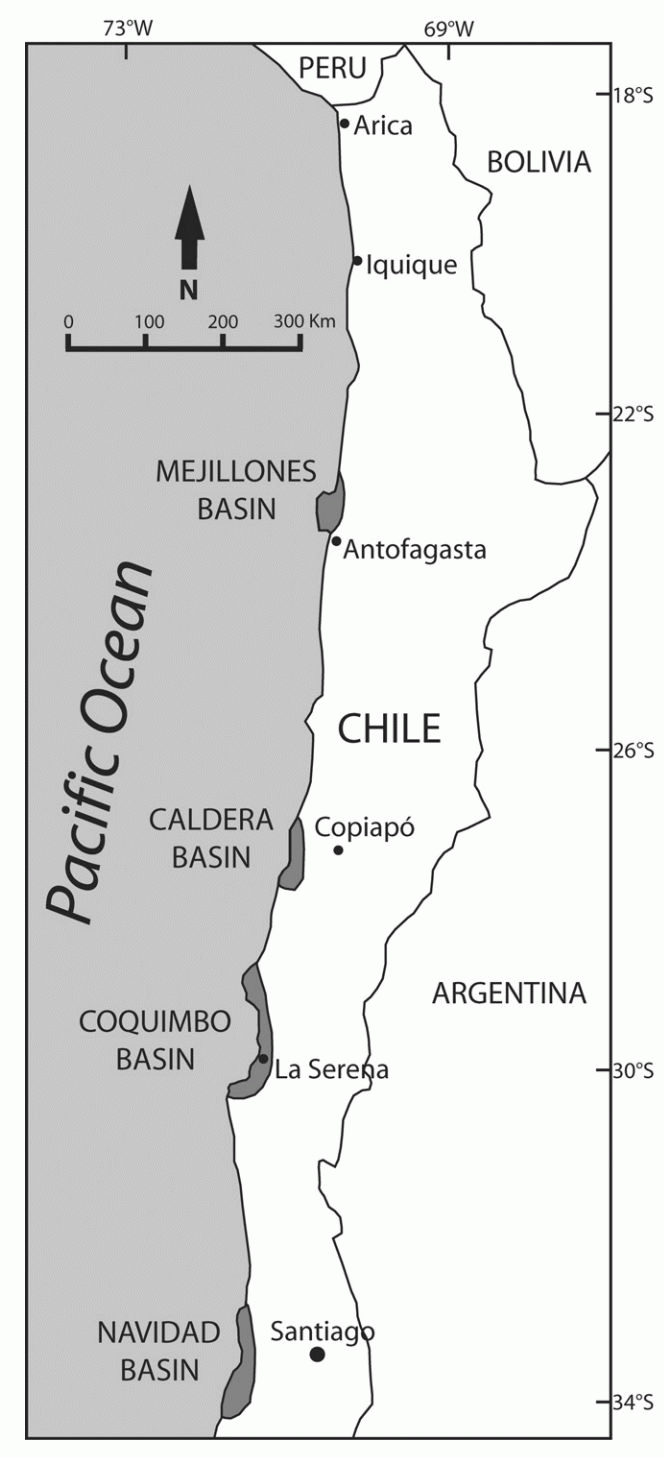
Figure 4. Late Cenozoic sedimentary basins on the west coast of northern Chile. From Feldmann et al.11 Click for larger image
First, they assign the ‘series’ and ‘stage’ by the field relationships among the strata and according to the fossils found therein.8 At this site they said that the fossil dating is complicated and probably not sufficiently precise to determine if the whales all died at the same time. Second, once the series and stage has been decided they simply read the ‘age’ in millions of years off the chart.
Figure 5. Immense boulder conglomerate toward the base of the Caldera basin indicating the high energy processes associated with the early sediment fill. Boulder deposits such as this have been connected with the receding waters of Noah’s Flood.14 Image from Pyenson Lab15
But how were the numbers determined for the chart? By agreement of an international committee which bases its thinking on the geological philosophy of uniformitarianism—a philosophy that only allows slow and gradual processes as explanations, or local catastrophes at the very largest.9 In other words, uniformitarian geologists are quite comfortable to hypothesise a storm, earthquake or tsunami, but not the global Flood.
On the other hand, drawing on multiple lines of evidence, biblical geologists consider the Flood a real event in history and the fossil layers to have been deposited mostly during this event. The Flood washes away the millions of years because it falsifies the assumptions on which the million-year ages are based. Most biblical geologists would accept that the standard geological column represents the general order of deposition during the Flood, with some of the uppermost parts of the column being deposited in the 4,300-year period afterwards.10
The sandstone strata containing the whale fossils are contained within a local area called the Caldera basin (figure 4).11
Similar localised basins are found at a number of places along the western coast of Chile. Although the basins are relatively small for Flood deposits, the characteristics of the sediments in these basins (figures 2 and 5) and the abundant fossils contained in them indicate that deposition took place during a period of rapid and major coastal subsidence.12 Coastal subsidence of this nature is exactly what we would expect in the second part of the Flood when the ocean basins sank, the continents rose and the floodwaters flowed into the ocean. And major coastal subsidence explains the rapid burial of the whales and other creatures because rapid burial was needed soon after death to preserve the fossils. After the ocean basins had mostly subsided and the waters had almost completely drained from the land, the whales and other animals that perished in the catastrophe were buried—toward the end of Noah’s Flood. As Robert Raeburn commented on one of the web news reports, the mystery disappears when we interpret the rocks and the fossils from a Bible perspective.